International Standards
Building acoustics is governed by a comprehensive set of international standards that define measurement methods and evaluation criteria. Understanding these standards is essential for selecting the right equipment.
ISO 16283-1
Airborne Sound Insulation
Field measurement of airborne sound insulation of partitions, floors and ceilings between rooms.
ISO 16283-2
Impact Sound Insulation
Field measurement of impact sound insulation of floors using the standardized tapping machine.
ISO 16283-3
Facade Sound Insulation
Field measurement of facade sound insulation against traffic and aircraft noise.
ISO 10140
Laboratory Measurement
Measurement of sound insulation properties of building elements under controlled laboratory conditions.
ISO 717-1/2
Single-Number Rating
Calculation of single-number quantities from frequency band measurement data.
ISO 3382
Room Acoustics
Measurement of room acoustic parameters including reverberation time and speech clarity.
Nor850 Software Supported Standards
Nor850 software supports a comprehensive range of international ISO and ASTM standards for acoustic measurements, building acoustics, sound power, and more.
ISO 3741
Reverberation room - Precision method
ISO 3743-1
Small movable sources - Hard-walled
ISO 3744
Engineering method - Free field
ISO 3745
Precision method - Anechoic chambers
ISO 3746
Survey method
ISO 3747
Engineering/survey in situ
ISO 140 (Legacy)
Traditional sound insulation standard
ISO 16283-1/2/3
New standard: Airborne, impact, facade
ASTM E336
Field airborne sound attenuation (US)
ASTM E1007
Field impact sound measurement (US)
ISO 10052
Field: airborne, impact & service equipment
ISO 10140
Laboratory sound insulation (multi-part)
ASTM E90
Lab airborne sound transmission (US)
ASTM E413
STC rating classification
ASTM E492
Lab impact sound transmission (US)
ASTM E989
IIC rating classification
ISO 354
Sound absorption in reverberation room
ASTM C423
Sound absorption coefficients (US)
ISO 3382-2
Reverberation time in ordinary rooms
ISO 3382-3
Open-plan offices
ISO 9614-1
Sound power - Discrete point measurement
ISO 9614-2
Sound power - Scanning measurement
ISO 15186-2
Sound intensity transmission loss
ISO 3822
Laboratory water supply installations noise
EN 12541
Taps and mixer noise requirements
BS EN (UK)
British Standards mirroring ISO/EN
DIN 4109-4 (Germany)
German building acoustics standards
JIS (Japan)
Japanese standards incl. impact ball testing
Key Parameters
Understanding acoustic parameters and their typical values helps you interpret measurement results and define project requirements.
Rw / R'w
Weighted Sound Reduction Index
Single-number rating for airborne sound insulation. Rw for laboratory, R'w for field measurements. Higher is better.
DnT,w
Weighted Standardized Level Difference
Airborne sound insulation normalized to reverberation time. Used for comparing rooms of different volumes.
L'nT,w
Weighted Standardized Impact Sound Pressure Level
Impact sound level normalized to reverberation time. Lower values mean better insulation.
RT60 / T30
Reverberation Time
Time for sound level to decay by 60 dB. T30 measures 30 dB decay and extrapolates. Critical for room acoustics.
C / Ctr
Spectrum Adaptation Terms
C for pink noise (living activities), Ctr for traffic spectrum. Added to Rw for specific noise sources.
STI
Speech Transmission Index
Measures speech intelligibility from 0 (bad) to 1 (excellent). Required for classrooms and lecture halls.
STC
Sound Transmission Class
North American rating for airborne sound insulation. Similar to Rw but with different reference curve.
IIC
Impact Insulation Class
North American rating for impact sound insulation. Higher values mean better insulation (opposite of L'nT,w).
Equipment Selection
Select the right equipment for your application. Recommended products are marked for the most comprehensive configurations.
The foundation of every building acoustics measurement system. Must be Class 1 per IEC 61672.
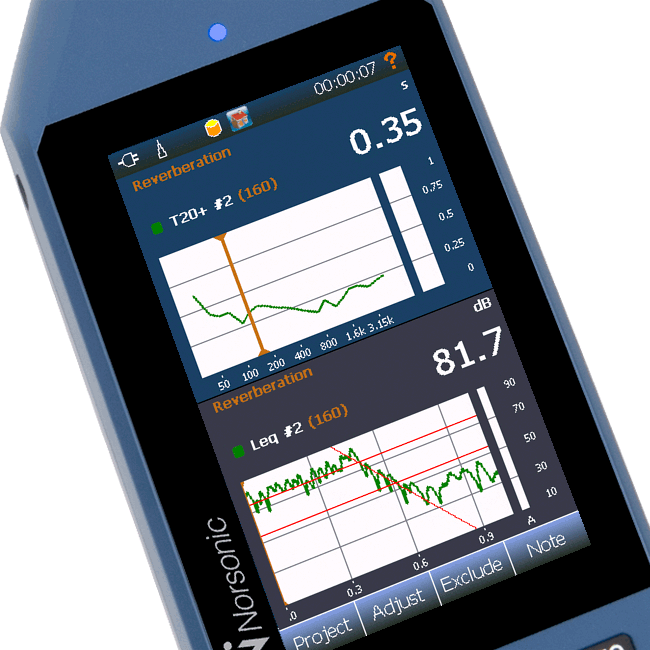
Nor145
Single-Channel Analyzer
- Sequential source/receive measurement
- Ideal for most applications
- Built-in 4G/LTE modem
- Octave & 1/3 octave analysis
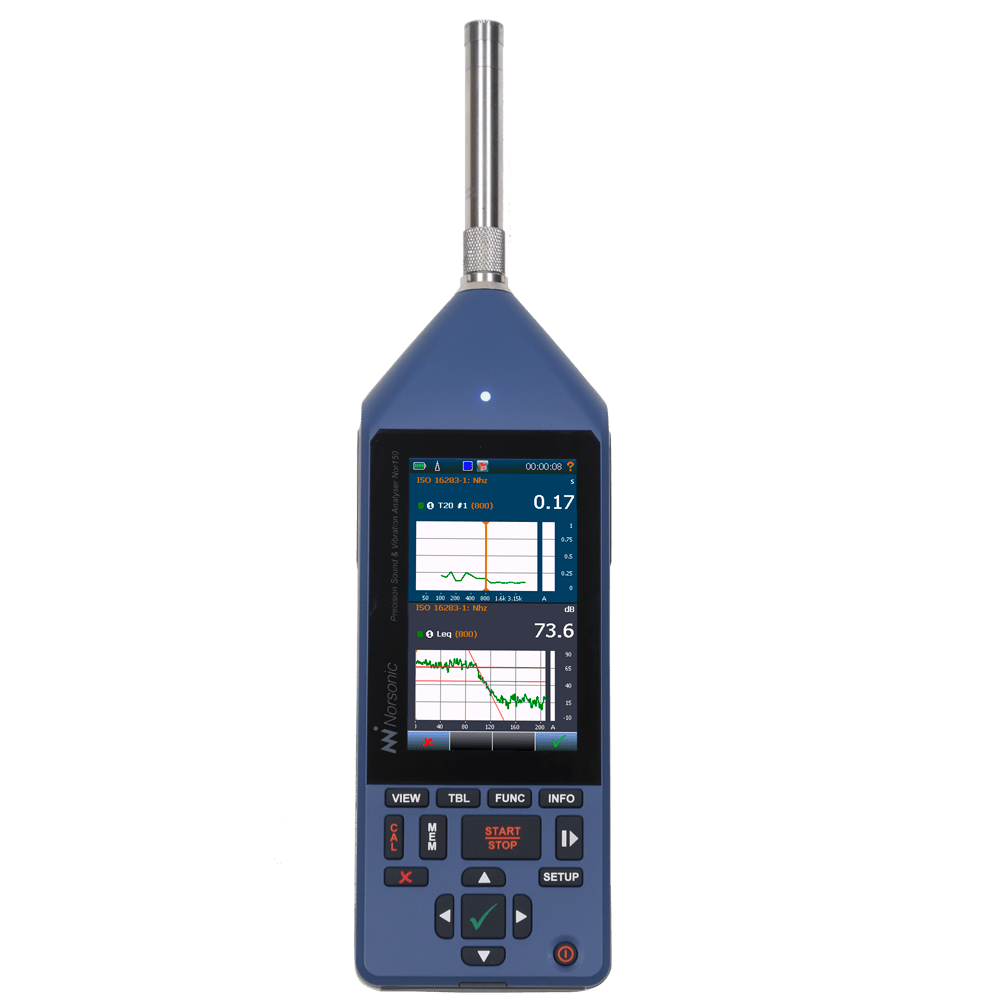
Nor150
Dual-Channel Analyzer
- Simultaneous measurement in both rooms
- Faster for multi-project work
- Required for cross-correlation
- Sound intensity capable
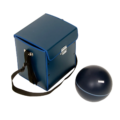
ISO 16283-1 compliant omnidirectional sound sources for testing insulation between rooms.
Nor283
Dodecahedron Loudspeaker
- 360° omnidirectional radiation
- ISO 16283 compliant
- 12 high-quality drivers
- 50 Hz - 10 kHz frequency range
Nor280
Power Amplifier 200W
- 200 Watts RMS
- Ideal for small/medium rooms
- Lightweight and portable
Nor282
Power Amplifier 500W
- 500 Watts RMS
- For large rooms
- Extended low-frequency response
ISO 16283-2 testing equipment for assessing floor impact sound insulation.
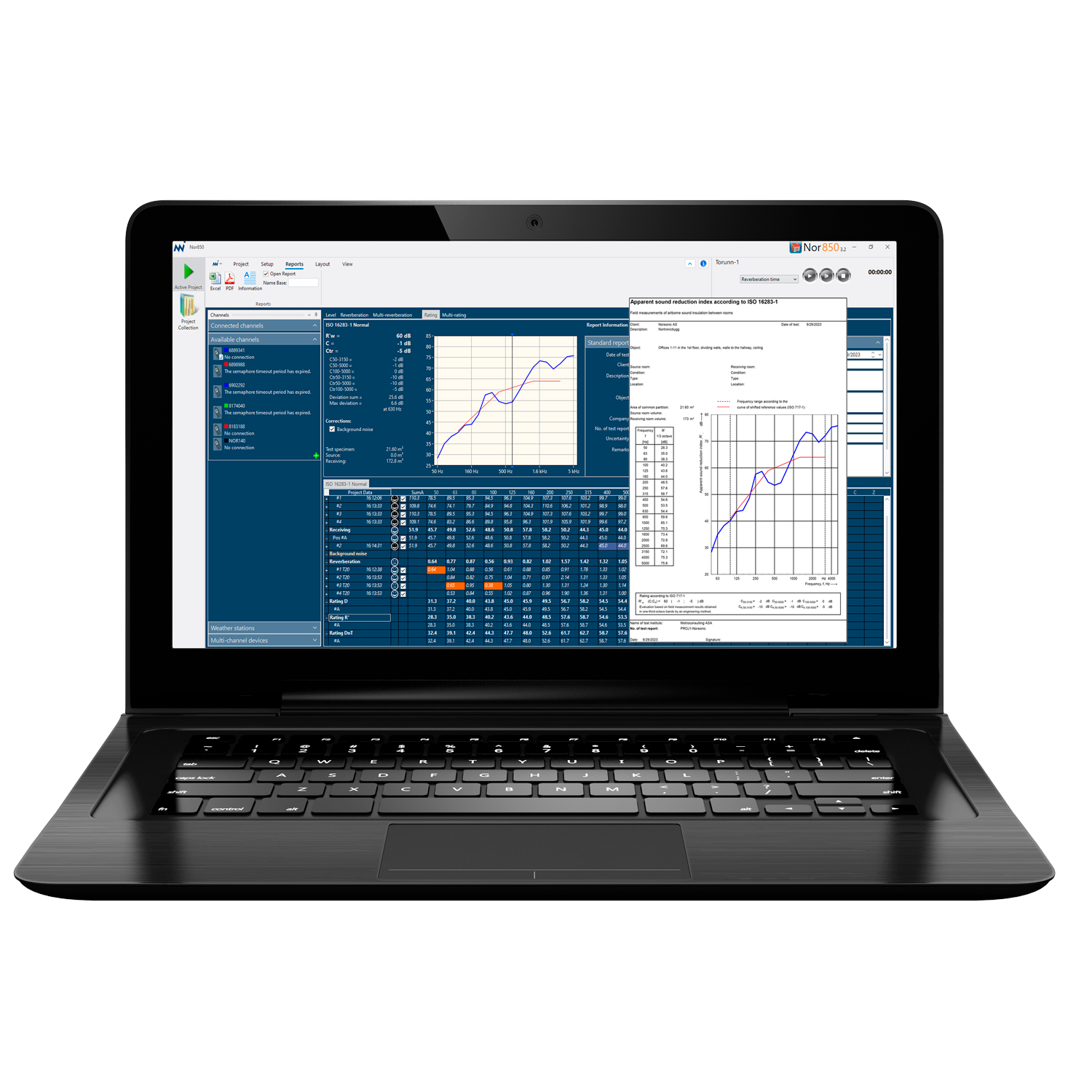
Automated calculations and professional report generation per standards.
Measurement Procedures
Follow these step-by-step procedures to perform building acoustics measurements correctly according to international standards.
- 1Set up the dodecahedron loudspeaker in the source room
- 2Generate pink noise and measure level in source room (L1)
- 3Measure level in receiving room (L2) at minimum 5 positions
- 4Measure reverberation time (T) in the receiving room
- 5Calculate DnT = L1 - L2 + 10 log(T/T0) where T0 = 0.5s
- 6Calculate single-number rating DnT,w per ISO 717-1
- 1Place the Nor277 tapping machine on the floor in source room
- 2Start the tapping machine (10 impacts/second)
- 3Measure sound level in receiving room (L2) at minimum 4 positions
- 4Measure reverberation time (T) in the receiving room
- 5Calculate L'nT = L2 - 10 log(T/T0) where T0 = 0.5s
- 6Calculate single-number rating L'nT,w per ISO 717-2
- 1Position sound source at minimum 1 location in the room
- 2Position microphone at minimum 3 locations (>2m from source)
- 3Generate interrupted noise or impulse sound
- 4Record sound level decay in each frequency band
- 5Calculate T20 or T30 from decay curve
- 6Extrapolate to RT60 and average all positions
Norsonic: the ultimate partner for building acoustic measurements
Frequently Asked Questions
Building Acoustics Applications in the GCC
Specialized acoustic testing solutions for key construction sectors across Saudi Arabia, UAE, Qatar, Bahrain, Kuwait, and Oman.
Acoustic testing for luxury hotels and resorts in Saudi Arabia, UAE, and Qatar. LEED/Estidama compliance, guest room STC requirements (STC 50+), and HVAC noise criteria (NC 25-35).
- STC 50+ between guest rooms
- HVAC noise criteria NC 25-35
- LEED & Estidama compliance
- Facade insulation testing
Acoustic privacy in hospitals, speech privacy per HIPAA equivalent standards, operating room noise control, and RT60 requirements for patient rooms.
- Speech privacy in consultation rooms
- Operating room noise control
- RT60 requirements for patient rooms
- Medical equipment sound isolation
RT60 optimization for speech clarity in mosques, Quran recitation intelligibility (STI > 0.6), dome acoustics challenges, and large congregation hall design.
- RT60 optimization for speech & recitation
- STI > 0.6 for Quran recitation clarity
- Dome and high-ceiling acoustics analysis
- Large hall sound system design
Saudi Vision 2030 education expansion, RT60 requirements (0.4-0.8s), background noise NC criteria, and speech intelligibility per IEC 60268-16.
- RT60 0.4-0.8s for classrooms
- Background noise NC 25-35 criteria
- Speech intelligibility per IEC 60268-16
- Vision 2030 education expansion
Saudi Building Code SBC compliance, party wall STC requirements, floor impact (IIC) testing, and NEOM and giga-projects acoustic specifications.
- SBC sound insulation compliance
- STC 50+ for party walls
- IIC floor impact testing
- NEOM & giga-project specifications
Open office speech privacy (D2,S per ISO 3382-3), meeting room insulation, and SBC 801 commercial requirements.
- D2,S per ISO 3382-3
- Meeting room insulation
- SBC 801 commercial requirements
- Speech privacy design
Saudi Building Code (SBC) Acoustic Requirements
The Saudi Building Code (SBC) defines minimum acoustic insulation requirements for residential and commercial buildings in the Kingdom of Saudi Arabia.
Residential Sound Insulation Requirements
Commercial & Office Requirements
Comparison with International Standards
ISO 16283
Field measurement methods adopted by SBC
ASTM E336 / E1007
STC & IIC ratings used in SBC
ISO 717-1/2
Rw & Ln,w calculation for international rating
ISO 3382
Room acoustics & reverberation time
SBC Compliance with Norsonic Equipment
All Norsonic building acoustics equipment is compliant with Saudi Building Code requirements. Nor850 software supports automated calculations and report generation per SBC 701 and SBC 801, with results exportable in both ISO and ASTM formats.