International Standards
Vibration measurements are governed by a comprehensive set of international standards covering human vibration, instrumentation, and machine monitoring.
ISO 8041
Human Vibration Measurement Instrumentation
Requirements and specifications for human vibration measuring instruments. Defines performance requirements for analyzers and sensors.
ISO 5349
Hand-Arm Vibration Assessment
Assessment of human exposure to hand-arm vibration from power tools. Compliant with EU Directive 2002/44/EC for exposure limits.
ISO 2631
Whole-Body Vibration
Assessment of human exposure to whole-body vibration in vehicles, buildings, and industrial environments.
ISO 10816
Machine Vibration Monitoring
Machine vibration evaluation by measurement on non-rotating parts. Acceptance criteria and limits for rotating equipment.
ISO 20816
Mechanical Vibration - In Situ Balancing
Measurement and evaluation of mechanical vibration for rotating machinery and in situ balancing procedures.
ISO 7919
Shaft Vibration Measurement
Measurement of rotating shaft vibration. Used together with ISO 10816 for comprehensive machine condition assessment.
Key Parameters
Understanding vibration measurement parameters and frequency weighting filters is essential for accurate exposure assessment and compliance.
ahv
Hand-Arm Vibration Acceleration
Frequency-weighted acceleration value of vibration transmitted through the hand when using power tools. Measured in m/s².
A(8)
Daily Exposure (8-hour normalized)
Daily vibration exposure value normalized to an 8-hour reference period. Used for comparison against exposure action and limit values.
aw
Whole-Body Weighted Acceleration
Frequency-weighted acceleration for whole-body vibration. Measured in three axes with different weighting for each axis.
VDV
Vibration Dose Value
Cumulative measure of vibration exposure giving more weight to peak events. Used when vibration is impulsive or contains shocks.
vrms
Machine Vibration Velocity
RMS vibration velocity of machinery. The primary parameter for evaluating rotating equipment condition per ISO 10816.
Wh, Wk, Wd
Frequency Weighting Filters
Wh for hand-arm vibration, Wk for vertical whole-body vibration, Wd for horizontal whole-body vibration. Simulate human body response.
GCC Applications
Vibration analysis has broad applications across construction, oil & gas, transport, and industrial sectors in the GCC for worker protection and equipment safety.
Construction Worker Safety
Hand-arm vibration assessment from power tools such as drills, hammers, and saws. Saudi labor law compliance for worker protection.
Oil & Gas Worker Protection
Whole-body vibration assessment on platforms and vehicles. Compliance with ARAMCO HSE requirements and major operator standards.
Mining & Quarrying
Drill operator vibration exposure assessment. Hand-arm vibration measurement from drilling and breaking equipment.
Machine Condition Monitoring
Predictive maintenance for rotating equipment. Early detection of imbalance and bearing failures to prevent unplanned downtime.
Building Vibration Impact
Construction vibration measurement and impact on adjacent structures. Protecting buildings from vibration damage during construction works.
Transport & Logistics
Whole-body vibration assessment for heavy vehicle and truck drivers. Compliance with occupational safety standards.
Required Equipment
Select the right equipment for your vibration measurement applications. The VA-14 is the specialist choice for human vibration assessment.
ISO 8041 compliant vibration measurement instruments for human vibration assessment and machine monitoring.
VA-14
Dedicated Vibration Analyzer
- ISO 8041 compliant
- ISO 5349 hand-arm vibration
- ISO 2631 whole-body vibration
- Built-in A(8) and VDV calculation
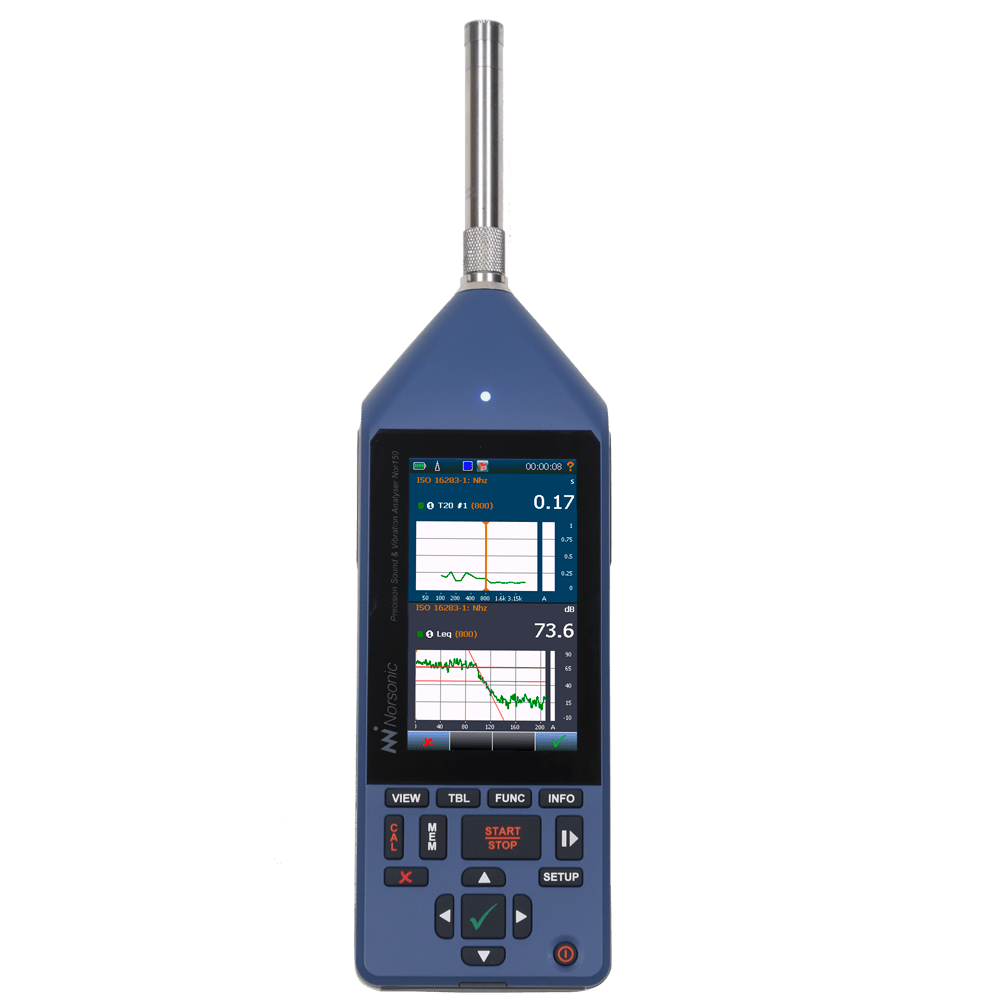
Nor150
Dual-Purpose Sound & Vibration Analyzer
- Combined sound and vibration measurement
- FFT and octave analysis
- Dual-channel capability
- Versatile multi-application use
Triaxial accelerometers and seat pads for human vibration and machine vibration measurements.
Vibration analysis and reporting software for exposure documentation and compliance.
Measurement Procedures
Follow these step-by-step procedures to perform vibration measurements correctly according to international standards.
- 1Mount triaxial accelerometer on tool handle using appropriate adapter
- 2Set analyzer to ISO 5349 mode with Wh frequency weighting
- 3Record vibration during normal tool operation for a representative duration
- 4Record actual exposure time for each tool during the work day
- 5Calculate A(8) = ahv x sqrt(T/T0) where T0 = 8 hours
- 6Compare result against action value (2.5 m/s²) and limit value (5 m/s²)
- 1Place seat pad with triaxial accelerometer on the driver's seat
- 2Set analyzer to ISO 2631 mode with Wk (vertical) and Wd (horizontal) weighting
- 3Record vibration during typical driving/operating conditions
- 4Calculate weighted acceleration in each axis (x, y, z)
- 5Determine highest axis and calculate A(8) for daily exposure
- 6Calculate VDV if vibration is impulsive or contains shocks
- 1Mount accelerometer at specified measurement points (bearings, housings)
- 2Measure vibration velocity vrms in the 10-1000 Hz range
- 3Compare values against ISO 10816 limits for the relevant machine class
- 4Record baseline measurements after installation or maintenance
- 5Establish periodic monitoring schedule and track trends
- 6Analyze FFT spectrum to identify vibration cause (imbalance, misalignment, bearings)